




On Thursday, the European Central Bank decided to keep interest rates unchanged amid significant economic uncertainty, as the European Union is racing to secure a trade agreement with the U.S. by the month's end.
The ECB has lowered interest rates at each of its four meetings this year, reducing the key deposit facility from 3% in January to 2% by June. Last year, it cut rates from a peak of 4%.
“The environment remains exceptionally uncertain, particularly due to trade disputes,” the ECB stated, noting that its inflation and growth projections from June are still supported by recent data.

Although annual inflation in the euro area reached the central bank’s 2% target last month, traders largely anticipated a hold in July — primarily due to geopolitical volatility. The U.S. stands as the EU’s largest bilateral trade and investment partner, with the 27-member bloc exporting 503 billion euros ($590 billion) in goods to the U.S. last year.
As of Thursday, the future of that trade relationship was still uncertain, with one scenario being a 15% baseline tariff rate on all EU imports to the U.S., alongside potential retaliatory measures from the EU.
ECB officials have indicated that their efforts to reduce inflation are nearly complete, as they aim for the neutral level where rates neither stimulate nor restrict growth. ECB Chief Economist Philip Lane told CNBC earlier this month that “the last cycle is done, bringing inflation down,” but emphasized that policymakers would remain vigilant regarding any changes in the medium-term outlook.
Growth risks ‘tilted to downside’
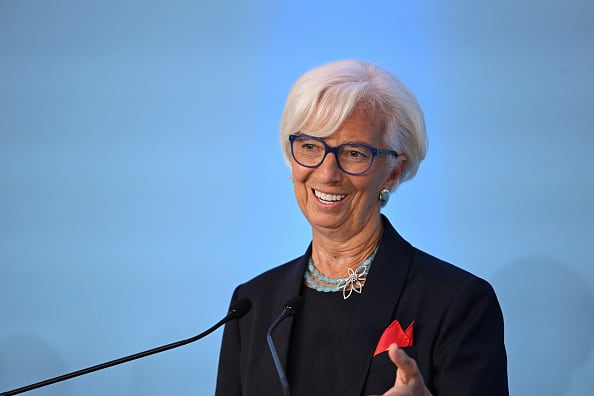
In a press conference following the decision, ECB President Christine Lagarde stated that the eurozone economy had performed better than anticipated in the first quarter. This was partially due to front-loading of exports ahead of expected tariff hikes, but also because of stronger private consumption and investment, rising real incomes, and more favorable financing conditions, she explained.
Highlighting the current uncertainty in forecasts, Lagarde noted that risks to growth were “tilted to the downside,” with escalating trade tensions potentially reducing exports, investment, and consumption, as well as affecting business and consumer confidence.
Conversely, a swift resolution in trade tensions, coupled with increased European defense and infrastructure spending, could drive growth higher than previously predicted in the coming months, she mentioned.
Investors are eager to determine whether the central bank is concerned about the recent appreciation of the euro, which could lead to deflationary pressures as imports become cheaper.
Lagarde remarked on Thursday that a stronger euro could “further decrease inflation beyond expectations” and that higher global tariffs could similarly suppress price increases if countries with excess capacity redirect their exports to the euro area. The euro experienced volatility following the ECB decision, trading about 0.08% lower against the U.S. dollar at 5:32 p.m. in London at $1.176. This is still an increase from a rate of around $1.026 at the start of the year, as investors have generally moved away from the greenback due to political and fiscal uncertainties.
However, Lagarde reiterated that the ECB is monitoring an alternative scenario where fragmented supply chains constrain the domestic economy and elevate prices globally. Higher fiscal spending and extreme weather events also pose a risk of increasing inflation, she said, describing the current situation as “wait and watch,” but noted that policy overall is in a “good place.”

All options open for ECB
Economists at RBC Capital Markets noted in a report that Lagarde’s press conference seemed to highlight positive signals from the euro area economy and minimize worries about inflation weakness, prompting them to adjust their forecast to maintain rates at 2% for the rest of the year.
Joe Nellis, an economic advisor at accountancy firm MHA, suggested that another rate cut might still occur in 2025, but the ECB would wait to see if 30% U.S. tariffs on EU goods from August 1 can be avoided.
“If a U.S.-EU trade agreement isn’t reached beforehand, the ECB might consider another rate cut in September to counteract the economic barriers imposed by tariffs,” Nellis explained.
Mark Wall, chief European economist at Deutsche Bank, noted that the ECB would keep all options available, which could even imply a potential return to rate hikes.
“If trade uncertainty diminishes, the combination of a robust economy and significant fiscal easing will eventually pose upside risks to inflation. Markets are not far from shifting focus from the last cut to the first hike,” Wall stated.


